Hampi
Boulder-Strewn Ruins of the Vijayanagara Empire • UNESCO World Heritage Site
About Hampi
Hampi is the haunting, boulder-strewn ruin of Vijayanagara, capital of the Vijayanagara Empire that ruled much of South India from the 14th to the 16th century. In its prime it was among the largest and wealthiest cities on earth, dazzling Persian and Portuguese travellers with its bazaars, palaces, and temples — until it was sacked after the Battle of Talikota in 1565 and abandoned. Today more than 1,600 monuments lie scattered over 25-plus square kilometres of banana plantations, paddy fields, and giant granite boulders along the Tungabhadra river, a landscape so surreal it feels invented.
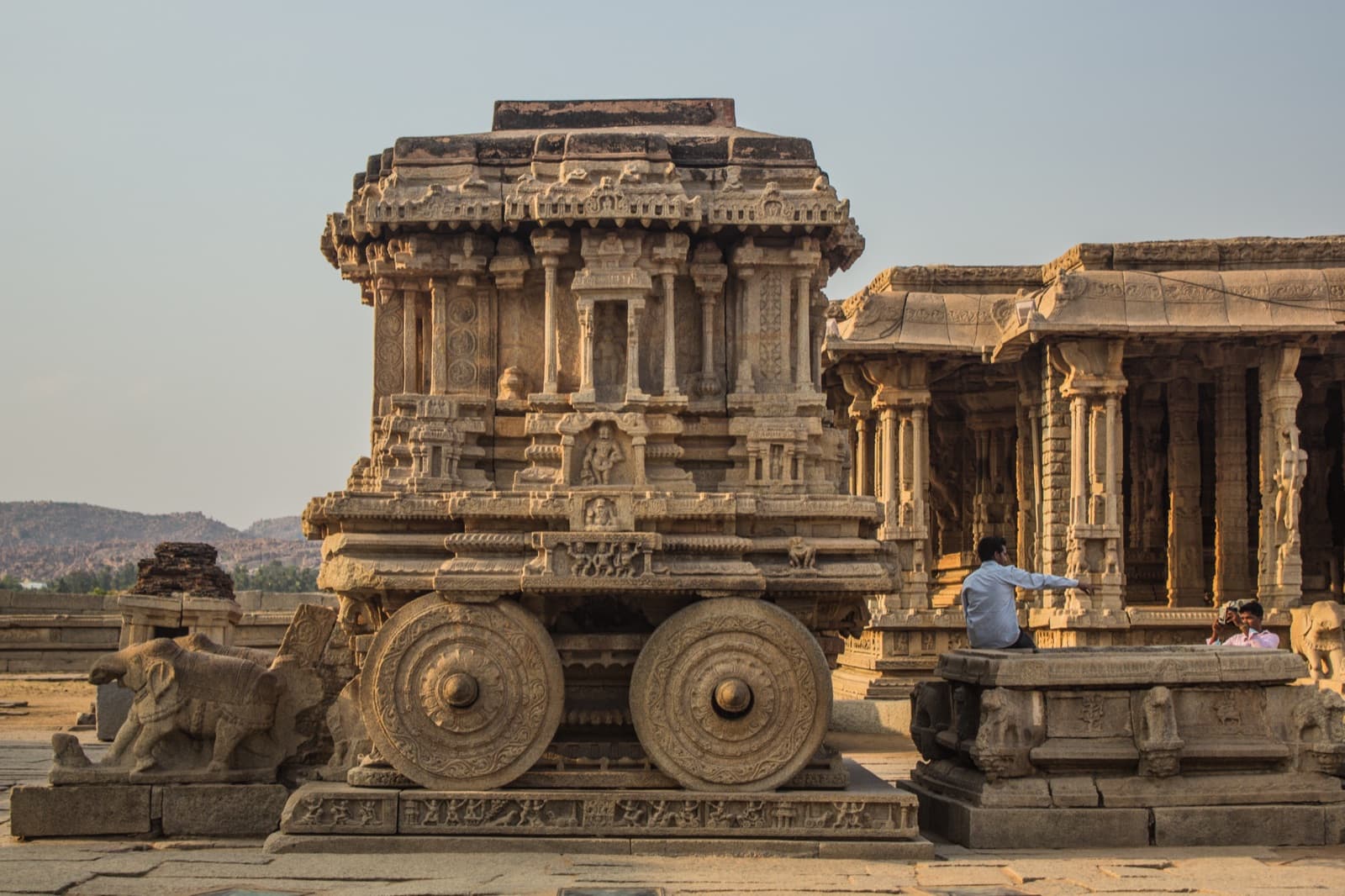
The living Virupaksha Temple still hums with worship at the heart of the site, while the Stone Chariot at the Vittala Temple has become an emblem of Indian heritage itself. Between sunrise hikes, coracle rides, moped loops, and lazy cafe afternoons, Hampi is as much a travellers' haven as an open-air museum — and a firm favourite on our solo travel collection for good reason.
Top Attractions
Virupaksha Temple
The soul of Hampi — a living Shiva temple predating the empire, its 50-metre gopuram towering over Hampi Bazaar. Look for the inverted-shadow pinhole chamber and Lakshmi, the temple elephant.
Vittala Temple & Stone Chariot
Vijayanagara art at its peak: the iconic Stone Chariot (of ₹50-note fame) and the famed musical pillars of the Maha Mantapa, reached by a lovely riverside walk or buggy ride.
Hemakuta Hill
A gentle boulder slope beside Virupaksha, dotted with pre-Vijayanagara shrines — the easiest and most popular sunset point, minutes from Hampi Bazaar.
Matanga Hill
The classic sunrise climb — a steep 30–40 minute scramble rewarded with a 360° panorama of the ruins, the river, and an ocean of boulders glowing gold.
Royal Enclosure & Lotus Mahal
The seat of the kings: the great Mahanavami Dibba platform, the stepped tank, and in the walled Zenana Enclosure the elegant Indo-Islamic Lotus Mahal pavilion.
Elephant Stables
A grand row of eleven domed chambers that once housed the royal elephants — one of Hampi's best-preserved structures, covered by the Vittala combined ticket.
Anjaneya Hill (Anjanadri)
Across the river near Anegundi, 575 steps climb to a hilltop temple revered as the birthplace of Hanuman, with sweeping views over paddy fields and the Tungabhadra.
Coracle Ride on the Tungabhadra
Spin gently downstream in a round basket-boat past boulder banks and half-submerged shrines — a centuries-old crossing turned into Hampi's most photogenic ride.
Best Time to Visit
October to February is prime season: dry, sunny days around 22–30°C, cool mornings perfect for the Matanga sunrise climb, and comfortable afternoons for cycling between the monument clusters. This is also when the Hampi Utsav festival of dance and music is usually staged among the ruins. Weekends and the December–January holidays get busy, so book stays ahead.
March to May is scorching — the granite landscape turns into a heat trap with temperatures regularly crossing 38–40°C; sightsee only in the early morning and late afternoon if you visit then. The monsoon (June–September) paints the paddy fields a brilliant green and swells the Tungabhadra, making it a moody, quiet, photogenic time, though coracle rides may pause when the river runs high.
Visiting Tips
- Beat the midday sun: start at sunrise, break from noon to 3 pm at a cafe, and resume in the golden hours — the boulders radiate serious heat, and shade is scarce among the ruins.
- Rent two wheels: a bicycle or moped is the best way to cover the spread-out royal centre; autos with fixed day rates work well if you'd rather not ride.
- Use the combined ticket wisely: the Vittala Temple ticket also covers the Zenana Enclosure (Lotus Mahal) and Elephant Stables on the same day — keep it handy and plan those together.
- Solo travellers do great here: guesthouses and cafes make it easy to meet people — just avoid wandering isolated ruins after dark and share your day plan with your stay.
- Mind the monkeys: keep food, sunglasses, and loose items zipped away on Matanga and Anjaneya hills — the resident troops are quick and fearless.
- Dress and cash: cover shoulders and knees for the living Virupaksha Temple, and carry cash — ATMs are limited in Hampi itself (more in Hosapete and Kamalapur).
Nearby Attractions
Anegundi Village
An older-than-Hampi village across the Tungabhadra, with the Anjaneya Hill Hanuman temple, Pampa Sarovar, banana-fibre craft workshops, and a slow rural rhythm.
Tungabhadra Dam
A vast reservoir and ornamental gardens on the edge of Hosapete — a pleasant evening outing with a musical fountain and sweeping views over the water.
Daroji Sloth Bear Sanctuary
A scrub-and-boulder reserve where free-ranging sloth bears amble out to the viewpoint most late afternoons, along with leopards, peacocks, and abundant birdlife.
Badami Caves
The rock-cut cave temples of the Chalukyas, carved into a red sandstone gorge above a green tank — pairs beautifully with nearby Aihole and Pattadakal for a heritage extension.
Frequently Asked Questions
October to February is the best time to visit Hampi, with pleasant days of 22–30°C that are ideal for walking and cycling among the ruins. The Hampi Utsav cultural festival is usually held in this window too. March to May is scorching, with the granite boulders radiating heat and daytime temperatures often crossing 38–40°C — if you must visit then, sightsee early morning and after 4 pm. The monsoon (June–September) turns the landscape green and the Tungabhadra full, but expect humid spells and occasional showers.
Plan 2–3 days. Day one covers the sacred centre — Virupaksha Temple, Hemakuta Hill, and the riverside path to the Vittala Temple and Stone Chariot. Day two takes in the Royal Enclosure, Lotus Mahal, Elephant Stables, and a sunrise or sunset climb up Matanga Hill. A third day lets you cross the river to Anegundi and Anjaneya Hill, take a coracle ride, or simply slow down at the cafes. A rushed single day is possible but does the site no justice — the ruins are spread over more than 25 sq km.
Hampi is the ruined capital of the Vijayanagara Empire, which flourished between the 14th and 16th centuries as one of the richest and largest cities in the world of its time. The Group of Monuments at Hampi was inscribed by UNESCO in 1986 for its more than 1,600 surviving remains — Dravidian temples, royal pavilions, aquatic structures, bazaars, and fortifications — set in a surreal landscape of granite boulders along the Tungabhadra river. The city fell after the Battle of Talikota in 1565, when it was sacked and abandoned.
The Vittala Temple is the artistic high point of Hampi. Its courtyard holds the famous Stone Chariot — actually a shrine to Garuda carved as an ornate chariot, the same one pictured on the Indian ₹50 note. Inside the temple’s Maha Mantapa are the celebrated musical pillars, slender granite columns that emit distinct musical notes when gently tapped (tapping is no longer allowed, to protect them). The Vittala ticket is a combined one that also covers the Zenana Enclosure with the Lotus Mahal and the Elephant Stables on the same day.
The classic way is on two wheels — bicycles and mopeds/scooters are rented cheaply in Hampi Bazaar and across the river, and the flat roads between monument clusters make for a wonderful ride. Auto-rickshaws offer fixed-rate day tours if you prefer not to ride, and the sacred-centre sites around Virupaksha Temple are easily walkable. For something memorable, take a spin in a coracle — the round, basket-like boats that have ferried people across the Tungabhadra for centuries.
Virupapur Gaddi, popularly called Hippie Island, is the laid-back area across the Tungabhadra from Hampi Bazaar, long known for its paddy-field guesthouses, riverside cafes, and backpacker scene. Be aware that much of it sits on regulated land, and authorities have periodically demolished or closed guesthouses there — so the scene shifts from season to season. Check the current situation before booking; nearby Anegundi village and the Kamalapur/Hampi Bazaar side offer dependable alternatives with plenty of homestays and hotels.
The nearest railhead is Hosapete (Hospet Junction), about 13 km away, connected by train to Bengaluru, Hyderabad, and Goa; buses and autos shuttle from Hosapete to Hampi. The closest airport is Vidyanagar (Jindal) Airport, about 35 km away, with limited flights from Bengaluru and Hyderabad; Hubballi Airport (~160 km) has wider connections. From Bengaluru (~350 km), the easiest options are the overnight sleeper buses to Hosapete/Hampi or the overnight Hampi Express train — both put you at the ruins by early morning.
Yes — Hampi is one of India’s most solo-friendly destinations. The village revolves around travellers, with welcoming guesthouses, sociable cafes, and plenty of other backpackers to team up with for sunrise hikes and moped days. Usual good sense applies: avoid isolated ruins after dark, carry water and sun protection against the fierce midday heat, and watch your snacks and sunglasses around the monkeys, especially on Matanga and Anjaneya hills. Hiring a licensed guide for a day is a nice way to unlock the history too.
Location & Map
Quick Facts
Entry Fees
The Vittala combined ticket also covers the Zenana Enclosure (Lotus Mahal) and Elephant Stables on the same day. Most other ruins are free to wander.
How to Reach
Hosapete (Hospet Junction), ~13 km away, has trains from Bengaluru (overnight Hampi Express), Hyderabad & Goa; autos and buses connect to Hampi.
Vidyanagar (Jindal) Airport, ~35 km, has limited flights from Bengaluru & Hyderabad; Hubballi (~160 km) offers wider connections.
Overnight sleeper buses run from Bengaluru (~350 km) to Hosapete/Hampi; KSRTC also connects Hosapete with Hubballi, Mysuru & Goa.
Bicycles & mopeds on rent, fixed-rate auto day tours, buggy to Vittala, and coracle crossings over the Tungabhadra.
Weather Guide
The granite boulders amplify daytime heat year-round — carry water, sunscreen, and a hat, and plan hikes for dawn and dusk.